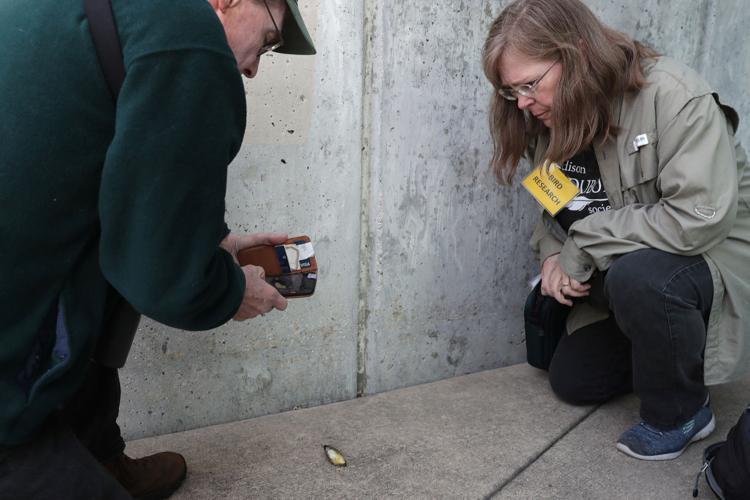
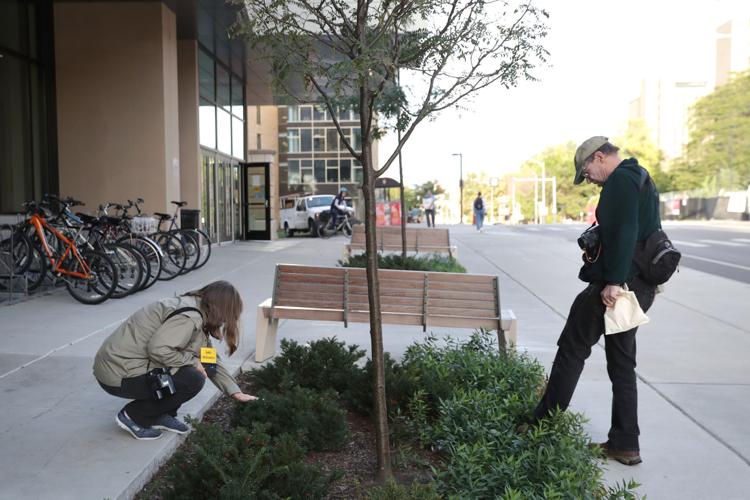
Bob Honig and his wife, Maggie, photograph a dead Tennessee warbler next to the Kohl Center. Volunteers with the Madison Audubon Society’s Bird Collision Corps, they monitor buildings each spring and fall to document where birds are flying into glass.
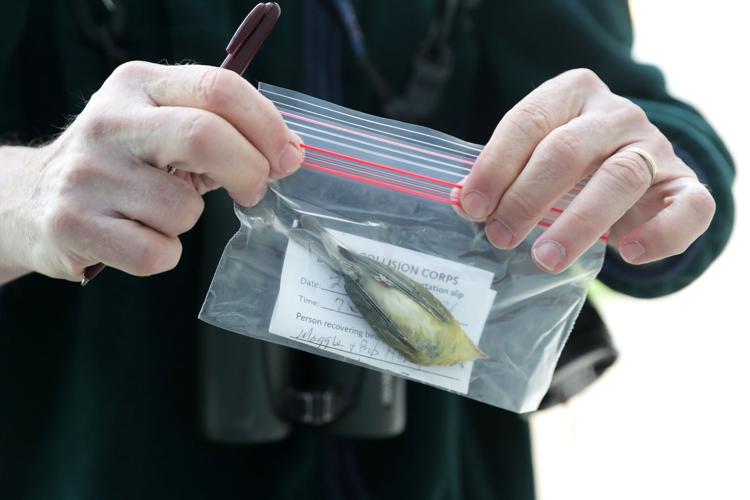
Bob Honig bags a Tennessee Warbler killed when it flew into a window at the Kohl Center. Window collisions are the second-leading cause of human-caused bird mortality.
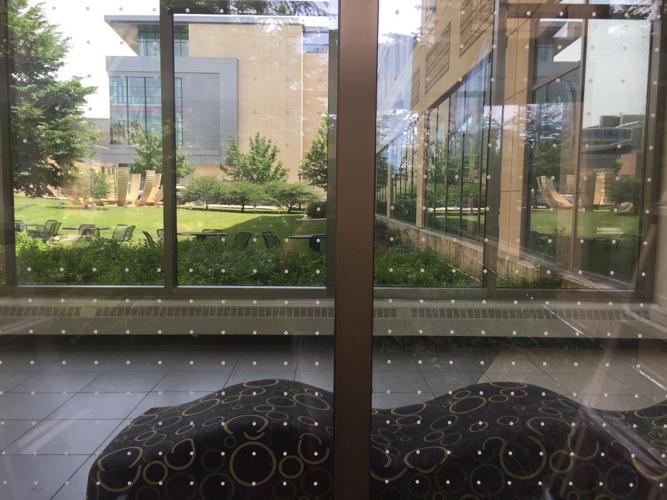
A grid of white dots was applied to windows at UW-Madison's Ogg Residence Hall after the Madison Audubon Society identified the building as a hazard for birds.
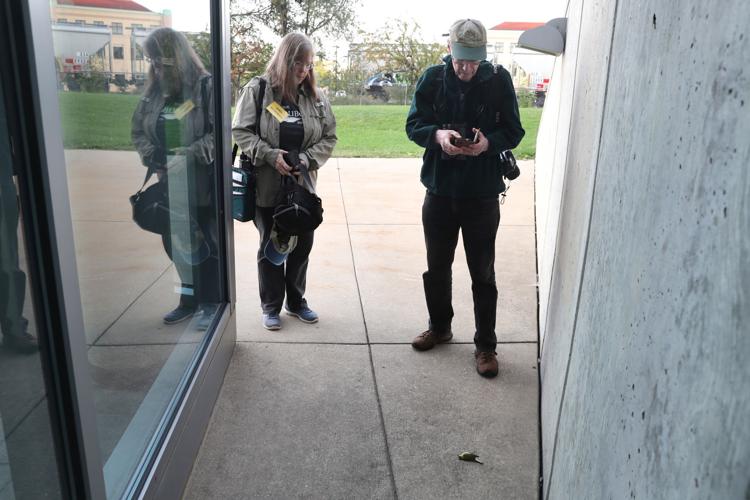
Maggie and Bob Honig look for birds along the sidewalk of the Nicholas Recreation Center at UW-Madison. Plans for the building prompted the Madison Audubon Society to begin gathering data on the number of birds killed by window strikes.
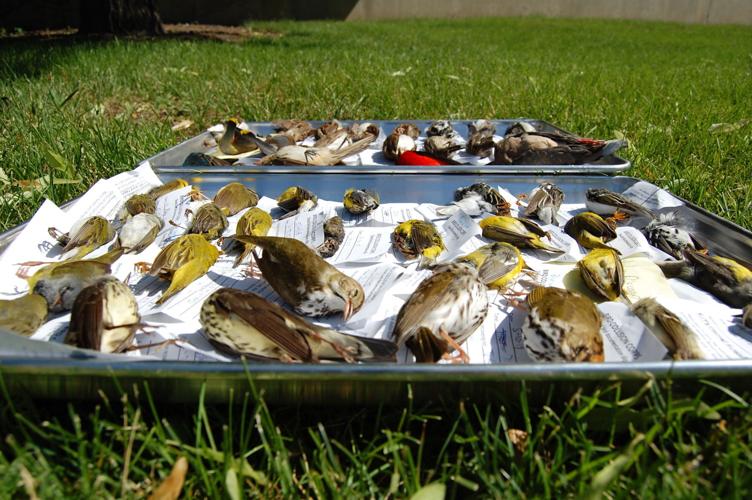
The Madison Audubon Society surveys buildings throughout Madison each spring and fall to document birds killed by collisions with glass. Volunteers typically survey one route in the early morning hours one day a week for about six weeks. To learn more or volunteer go to www.madisonaudubon.org/bcc.
Bob Honig and his wife, Maggie, photograph a dead Tennessee warbler next to the Kohl Center. Volunteers with the Madison Audubon Society’s Bird Collision Corps, they monitor buildings each spring and fall to document where birds are flying into glass.
Bob Honig bags a Tennessee Warbler killed when it flew into a window at the Kohl Center. Window collisions are the second-leading cause of human-caused bird mortality.
A grid of white dots was applied to windows at UW-Madison's Ogg Residence Hall after the Madison Audubon Society identified the building as a hazard for birds.
Maggie and Bob Honig look for birds along the sidewalk of the Nicholas Recreation Center at UW-Madison. Plans for the building prompted the Madison Audubon Society to begin gathering data on the number of birds killed by window strikes.